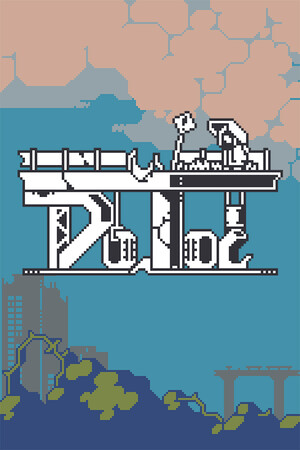
A farming sim with a distinct setting
Doloc Town avoids the familiar inherited countryside farm by placing its growing space inside a damaged industrial world. The player begins as a scavenger and builds a farm from recovered materials while communities live among trains, bridges, ruins, and repurposed structures. Acid rain and other severe weather make the environment relevant to everyday farm work. The setting gives routine upgrades the feeling of repairing a place rather than simply decorating a larger property.
The side-scrolling view reinforces that identity because the farm expands vertically across platforms. Building upward makes limited space part of the design and visually ties the farm to surrounding machinery and ruins. Exploration also uses the side view for platforming, hidden routes, and environmental obstacles. Players who want a conventional overhead farm may need time to adjust, but the layout is one of the game's clearest differences from its genre peers.
The interconnected progression is the highlight
The farm sits at the center of almost every major system. Crops provide money, request items, and cooking ingredients while also contributing to crafting, research, and later exploration. Materials found outside town return home as tools, machines, or new production lines, and those upgrades then open access to additional regions. Progress rarely serves only one goal, which gives the familiar plant-water-harvest routine a larger strategic context.
That connection can turn a simple objective into a long chain of prerequisites. A complete-release review describes a needed material requiring a press, electricity, a generator, refined metal, fuel, and technology unlocks before the original request could be completed. This complexity is satisfying when players enjoy planning and optimization. It can feel slow when someone wants the main quest to move forward without several days of infrastructure work.
Farming depth and automation
Official launch material lists more than 30 crops, more than 40 resources, more than 80 crafting recipes, and over 10 building types. Farming grows into animal care, fishing, cooking, crop genetics, processing, platform construction, and automated production. New mechanics arrive gradually, which the reviewer found easier to learn than receiving every responsibility at once. Early farm layouts can be messy, but rebuilding them is part of the intended optimization loop.
Version 1.0 adds Farming Automation through Industrial Tech Tree nodes, equipment, and tutorial quests. The late-game idea is to move repetitive work toward drones and machines so the player can explore, follow stories, or improve the overall design. A reviewer reported drones harvesting while other machinery processed resources in the background. Exact unlock timing varies by progress, but automation gives the expanding farm a meaningful destination instead of allowing chores to grow forever.
Exploration and the Old City Ruins
The official release describes three large map areas containing outskirts, mines, forests, valleys, wetlands, caves, and the Old City Ruins. Each region contains resources, hidden routes, clues, and enemies connected to the game's wider mystery. Version 1.0 adds the Old City as the final major region and uses it to conclude the main storyline. Exploration is therefore a major source of farm progression rather than a detachable side activity.
The drawback is the amount of travel required before transport becomes convenient. A complete-release review says an early dash helps movement but does not remove long trips, while buses require time and investment before becoming practical. Forgetting one crafting material can force a return home, especially before storage improvements are available. Players who like gathering loops may accept that rhythm, while players sensitive to backtracking may see it as the game's most persistent friction.
Combat works as a supporting system
Doloc Town uses a customizable combat drone for bullet-hell encounters during exploration. The drone can be controlled manually or allowed to fire automatically, and components support different builds. Version 1.0 rebalances firearms, enhancement chips, drone battery statistics, support modules, monster defenses, and several weapon behaviors. New drones, components, enemies, and Old City encounters broaden the launch build.
The cited reviewer describes combat as serviceable rather than the main attraction. It adds danger and variation to resource runs, but it does not try to match a dedicated action game in precision or depth. That balance suits a cozy farming audience that wants occasional conflict without turning every expedition into a demanding challenge. Players shopping mainly for platform combat should set expectations around farming and management first.
Story, residents, and friendship
The premise follows a return to a hometown damaged by war and a search connected to restoring the wasteland. Version 1.0 adds the last main quests and brings the larger mystery to a conclusion in the Old City Ruins. A complete-release review finds the opening premise strong but several later story beats predictable. Its pacing also slows whenever material gates redirect attention toward production chains.
The residents become more compelling through friendship events and personal quests. Official material confirms relationship storylines for 13 townsfolk, festivals, and four additional 1.0 storylines for Zenis, Villain, Cod, and Hult. Conversations and gifts build friendship according to complete-release coverage, but that coverage reports no romance. The social system focuses on people continuing their lives after devastation rather than on dating or marriage.
Pace, pressure, and playtime
Doloc Town lets players ignore the main story for long stretches while reorganizing the farm, exploring, or preparing for another season. Days move quickly, yet a complete-release review says the experience remains relaxed unless a timed request is active. This freedom is central to the cozy feeling and also one reason the narrative can lose momentum. Players decide whether a detour feels rewarding or like an interruption.
The official launch announcement estimates more than 30 hours of core play and over 100 hours of additional content. A reviewer passed 30 hours on a first complete playthrough and still had areas, machines, and farm ideas left unfinished. Those numbers support substantial scope without promising one universal completion time. Optimization-focused players are especially likely to spend longer rebuilding and automating.
Value and buying decision
At the August 6, 2026 launch check, the US Steam page showed a $19.99 base price and a temporary two-week 20% discount. Regional prices and promotions vary, so the live store must be checked before purchase. The complete release includes the story ending, Old City Ruins, automation, finished Tech Trees, more relationship content, fish, tools, drones, and achievements. Existing Early Access owners receive the full-release update without buying the game again.
The best audience is someone who enjoys improving a farm several steps at a time and does not mind rebuilding an inefficient layout. The weaker fit is a player wanting a very simple crop routine, constant story momentum, or deep action combat. Doloc Town earns its recommendation through the relationships among systems rather than through any single mechanic. Its ability to make one more upgrade lead naturally to another is both its greatest appeal and the source of its pacing problems.
Review verdict and sources
The verdict is positive with clear qualifications. Doloc Town 1.0 offers a distinctive vertical farm, a cohesive rebuilding theme, extensive connected systems, and a satisfying path toward automation. Backtracking, material gates, and secondary combat prevent it from being effortless, but they do not erase the strength of its management loop. Players who want a cozy farming game with more exploration and infrastructure should find the trade worthwhile.
This page is a review overview based on clearly attributed complete-release coverage and facts from the official Steam Community launch notes. It does not claim that the site operator personally completed the game; subjective judgments remain attributed to the published coverage, while counts, systems, and version changes come from official material. Current Steam review totals are omitted because they change. Unsupported exact values are not presented as facts.